
Caskets are the key element of just about any memorial service – except in some cases in which a body is cremated, but, even then, caskets do often play a central role. Yet they are often a mystery to many people who are planning the funeral and burial of a loved one. The lack of basic knowledge about caskets can lead to confusion, frustration and even intimidation for grieving family members as a funeral director or cemetery sales person guides them through a show room filled with a wide variety of caskets to choose from. There is often a great deal of price difference between the various models that most showrooms have, and, further still, there is often an even greater selection of caskets available for sale online.
Anyone who is planning a memorial service for a family member would do well to know a little about some of the basic elements of a caskets. This knowledge could help a family save hundreds or even thousands of dollars and it will assure that a deceased relative’s remains are handled in the precise manner that he or she – and others in the family – would desire and need. It is for this reason we offer the following basic facts about the elements of a casket.
Shape of a Casket
In today’s world, most caskets that are available on the retail market resemble a mobile, individual-sized bed. They are usually rectangular in shape and offer a sturdy, sleek, and stylish design. In many ways they resemble the jewelry boxes of yesteryear in which families tucked away their precious pieces when they were not in use. In fact, it is not a coincidence that those boxes were also called “caskets.” In the late 19th century and early 20th century, when the demand for ornate funerals and memorial services was growing quickly across the United States (and the world, for that matter) the relatively new profession of “funeral director” required a great deal of creativity be employed if a funeral home was to remain competitive with the many new players in the funeral industry. This meant many new innovations were constantly being added to the funeral director’s stable of products he or she could offer to families seeking to remember their loved ones in increasingly sophisticated, yet dignified, ways. The resulting marketing creativity brought about the advent of caskets as we now know them. Before the heavily constructed, rectangular shaped box came into vogue, most deceased were buried in hexagonal shaped coffins – the kind that are now mostly seen in movies about vampires or in western films. To better understand these options, you can explore What Are the Different Types of Caskets for a more detailed look at available styles.The marketing prowess that developed among funeral directors in the golden age of their industry saw that customers wanted to be able to tuck their deceased loved ones away for safe keeping just the way families store their precious jewels in a casket. While, of course, a casket intended a human body will not preserve its contents in the same way that a jewelry casket will, the idea of such a thing proved exceedingly comforting (and popular) with families. Accordingly, the look of today’s “traditional” casket has evolved to the point that the burial container that is actually deserving of the adjective tradition – the old fashioned coffin – is almost an afterthought in today’s funeral and burial products market.
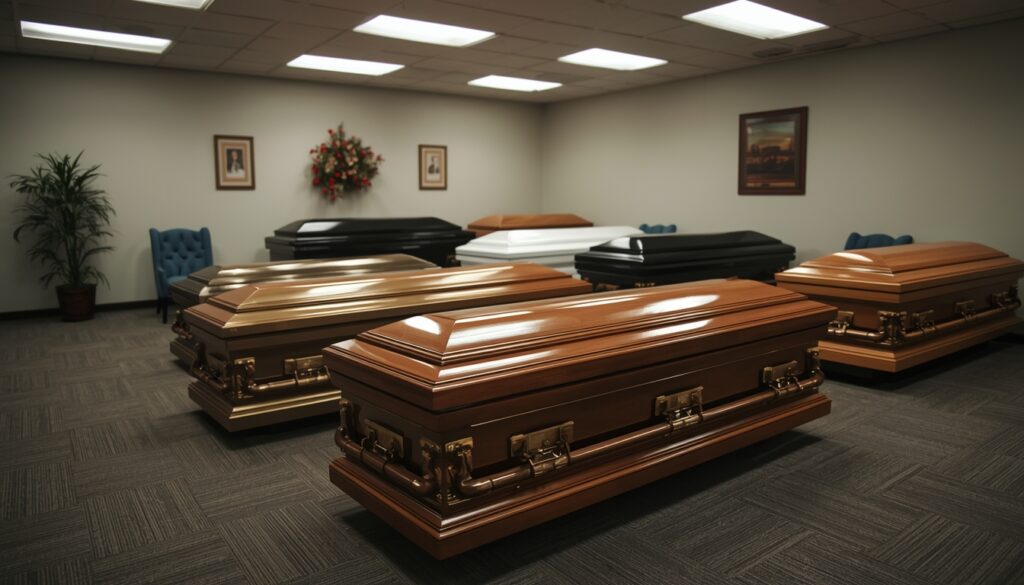
But that is not to say that the hexagonal shaped coffin is no longer available or even entirely off limits to those who may want to memorialize their loved ones in such a vessel. In fact, some analysts of memorial product trends detect that the “traditional” coffin may be making a comeback. As many people move to cut back on what are sometimes deemed “excesses” of modern funeral and burial traditions, the idea that simpler is better is gaining headway. So, for those who desire a traditionally shaped coffin rather than a sturdy, rectangular casket, the option is definitely available – a family may just have to seek it out.
So the point to remember about the shape of a casket when touring a funeral director’s show room is that other shapes besides rectangles are available if a family wishes to pursue the option on behalf of the deceased. In fact, in some ultra-modern burials that are more concerned about environmental friendliness than on decorum, a “casket” could even be said to be round, as some burials are conducted in which a body is curled up into a fetal position, covered with a biodegradable bag, and simply planted in ground upon which a tree or some other bit of memorial vegetation will be transferred. While it is true that this sort of “casket” is unlikely to be placed on display during a funeral service (as rectangular caskets are often available for rent during funerals for people whose body is to be disposed of via cremation or some other, potentially unsightly, manner), it is important that customers have as much information as possible when they are deciding upon which elements of a casket are most important to their needs.
Materials of a Casket
Caskets today are typically made of two main types of materials, either metal or wood. This element of a casket is important for those considering the longevity of the casket’s life. Because the casket will likely be buried under ground – or housed, well out of sight, in a mausoleum niche – the longevity might not be a vital issue for most families. Customers working with a funeral director or cemetery sales person should keep this in mind when being presented with sales pitches that include references to how long a casket will last underground. If there is no intention to remove a body from its final resting place, such a factor if largely irrelevant. This element of a casket should be chosen, then, on stylistic factors and, perhaps, on issues that are important to many modern day consumers such as the environmental factor. Wooden caskets, of course, will likely decompose much more quickly than metal caskets, but that is not always the case, as rust in warm, tropical climates has been known to eat away quite readily at some metal caskets. And even hard wood caskets that are coated with sufficient stains and pains will sometimes retain their composition for much longer than a family may have anticipated.
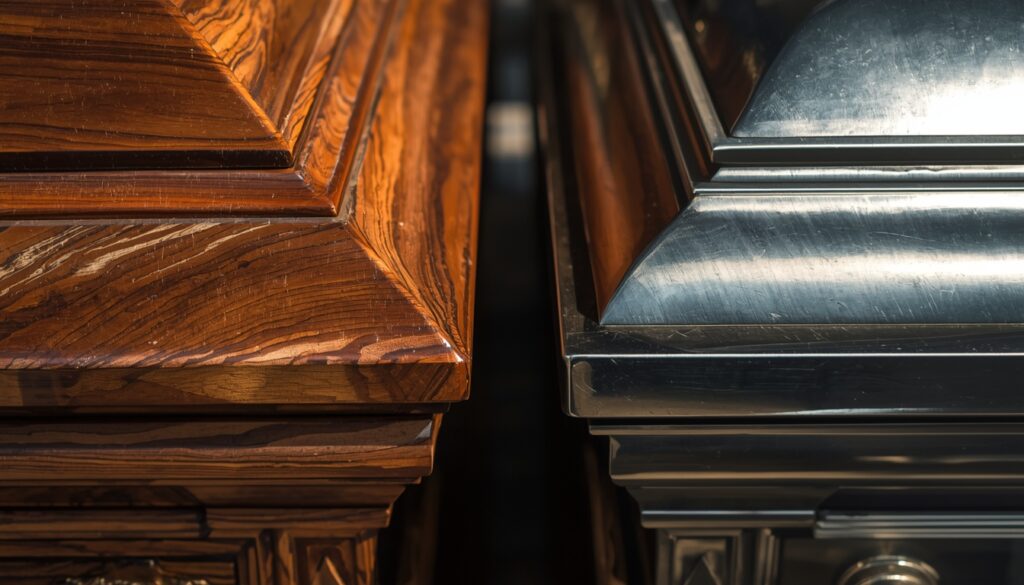
In general, the choice of wood or metal casket is almost entirely a matter of aesthetics – even if a sales person may try to convince a family otherwise. Generally speaking, there is little practical reason to choose a wood casket over a metal casket. Decisions on this particular element of a casket should be made entirely upon the tastes of those who are planning the memorial service and, if known, upon the desires of the deceased.
Interior of a Casket
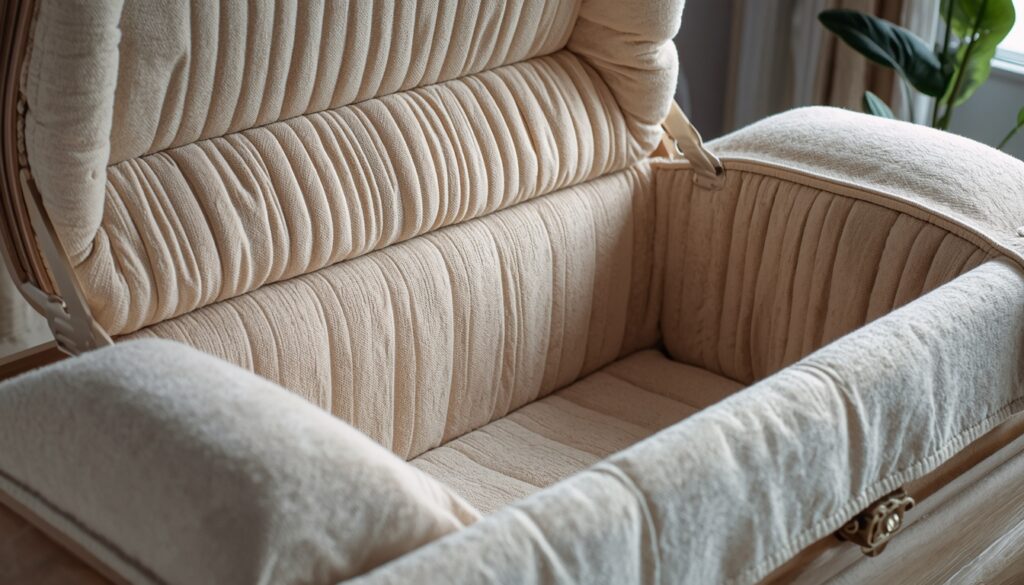
The interior elements of a casket are typically the very similar in most commercially available caskets on today’s market. Any differences, as with the materials of a casket discussed above, are mostly cosmetic. Some casket models have thicker mattresses or cushions or sheets that have a more elegant look, but, in general, this element does not differ much according to the model of casket – though prices for various models can differ greatly. When customers are deciding upon this element of a casket, they are best served if they remember that any decisions they make will be of note only during the memorial ceremony itself. Even the least expensive models of caskets available from memorial product suppliers today will typically feature extraordinarily plush interior designs that will be impressive and comforting to those who will be viewing the body during a special ceremony or before the funeral itself. It is true that the more expensive casket models will feature interior elements that will, perhaps, remain longer intact while underground. But, as we have said repeatedly so far in this article, if a casket is not intended to be opened or moved after the deceased has been laid to his or her final rest, the added quality of interior fabrics and designs may end up being lost.
Exterior of a Casket
Perhaps the greatest concern for customers deciding on options for the exterior elements of a casket is the use of a gasket, a piece installed on the lid of the casket and intended to seal the box tightly shut once it has been under ground. The use (or even sale) of these casket elements is somewhat controversial because, critics of the funeral home industry say, they are almost entirely unneeded. Though some who buy caskets with gaskets added to the lid may believe that the deceased’s body will be protected from decomposition once it is lain to rest in the grave, many years of scientific and anecdotal evidence alike will show otherwise. If anything, when a gasket is added to a casket that is then buried beneath a hot and wet surface filled with tropical subterranean life, the decomposition process will speed up in some cases. (Though predicting decomposition times is very tricky business, of course.) Some families choose a gasket for a casket (which can add hundreds of dollars, sometimes more than $1,000 even to the price of a casket) because they desire the peace of mind of knowing that their loved one is protected as well as can be from the elements. This is purely an emotional reason for making this purchase, however, and it is important that customers realize that. Though many state and federal laws prohibit funeral directors and other sales people from claiming outright that a gasket-lined casket will protect a body indefinitely from the elements, it has been documented that some salesmen, while not technically violating the law, do little to discourage false notions in their customers that a gasket will make an entombment more or less permanent. It is for this reason that those who are planning a memorial service for a loved one should remember that the funeral director has a vested, financial interest in making an added sale.
Another optional casket element available fairly readily today is exterior containers, little compartments in which a family can stash a variety of items that were of importance to the deceased – military medals, marriage certificates, even Bibles or important letters. These elements of a casket can end up driving the cost of a casket more than $1,000 higher than a model without compartments. And, as with nearly every other element we have discussed so far in this article, many families discover that the items that a deceased person may have desired to carry with him to the grave are just as easily placed inside the casket itself, right next to the body. Many a deceased body has been buried, in fact, with his or her favorite Bible upon the chest, held securely by his hands. Today’s caskets are typically designed so as to not encourage a tight fit for the body. Therefore, there is usually ample room to toss any number of mementos of a life well lived into the box with the body. And this can be done regardless of whether the casket has exterior compartments or not. More than one case has been documented, in fact, in which a family purchased an expensive casket model that had, among other things, several outside exterior containers for mementos – only to see those containers go beneath the ground with the body completely empty. Mourners in these cases insisted that the various items rest in the casket’s main compartment where the deceased could “see” them. What good is a Bible, after all, if it’s in a compartment on the exterior of a casket – where the deceased could have absolutely no access to it, even if he or she wanted. Many historians have been known to criticize the practice of burying memento with a body. Their argument is, typically, that the various items can probably do more good above the ground circulating among people who can appreciate and learn from them than they can rotting away for eternity in a musty, dark and dirty grave.